
David Knoup
President, Ticomix
You have probably heard both of these claims in the last month: AI is the biggest shift in business since the internet. And AI is mostly hype that has not paid off.
Here is the uncomfortable part: both are true, and the numbers back each side. MIT researchers studied 300 enterprise AI deployments and found that about 95 percent of pilots stalled without measurable impact on the P&L. Meanwhile Intuit’s 2026 AI Impact Report found 78 percent of US businesses saying AI has improved their productivity and 43 percent saying it has increased revenue.
Same technology, same two years, opposite results. After 25 years of building and modernizing business software, I can tell you the difference is not the AI. The MIT team said it plainly: the failures came down to integration, not model quality. The companies getting nothing out of AI are using it disconnected from their business. The companies getting real results connected it to the systems they run on.
TL;DR
- Most AI pilots fail because the AI cannot see the systems the business runs on.
- Vendors are building AI connectors (known as an MCP connector) for mainstream platforms like QuickBooks. No one is building them for custom and industry-specific applications, but they can be built.
- Connected applications give you plain-English answers, on-demand reporting, and automation across every system you run. You control what the AI sees, and you can start read only.
- Start with one question you wish your systems could answer, take inventory of your applications, and connect one system.
- If Ticomix built or maintains your application, we can connect it. One conversation is enough to find out what it would take.
Looking for the broader picture on AI and business systems generally? See our article on AI Integration in Business.
AI Disappoints When It Cannot See Your Business
Think about what a tool like ChatGPT or Claude actually is the first time you open it. It has read more than any person alive. It can reason through problems, write clearly, and analyze whatever you put in front of it.
And it has never seen your business. It does not know your customers, your jobs, your margins, or your inventory. So people use it for what it can see: writing emails, summarizing documents, research. Useful, but nowhere near the transformation everyone keeps promising. That gap between the promise and the email drafting is exactly where most of that 95 percent lives.
A brilliant consultant locked in a room with no phone and no files.
Mainstream Software Is Getting Connected
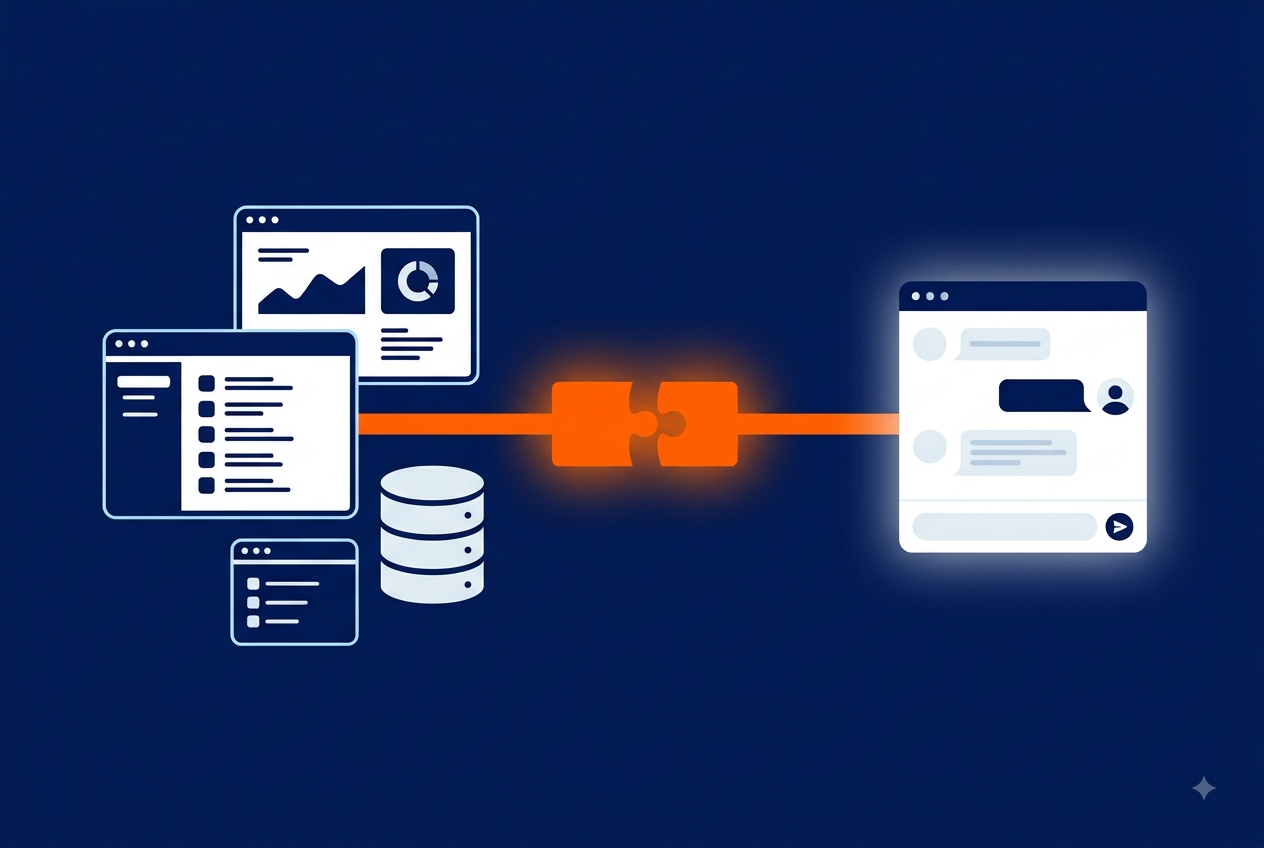
A couple of years ago the industry settled on a standard way to connect AI tools to business systems. It is called the Model Context Protocol, MCP for short. You do not need to remember the name. What matters is that an MCP connector works like a controlled doorway: the AI can look into an application and, only where you allow it, take action there. The standard is not new. What changed recently is availability: every major AI provider now supports it, and ready-made connectors exist for hundreds of business applications.
QuickBooks now connects directly to both Claude and ChatGPT, and Intuit signed multi-year partnerships with the companies behind both. A business owner can ask about cash flow or create an invoice by typing a question in plain English. Bookkeepers report month-end closes that used to eat 2 to 6 hours now taking about 20 minutes.
We see the same thing inside our own walls. We connected our CRM to Claude last year. Questions that used to mean building a report, or waiting for someone who knew how to, now take about as long to answer as they take to ask. Which deals moved this month. Which campaigns produced actual pipeline.
And the honest version of this story includes the friction: our first connection took longer to set up than it should have, and we spent real time deciding who should be able to see what. That time was not wasted. It was the actual work.
Nobody at Ticomix has built a conventional sales report in months.
How an MCP Connector Works
What a Connected System Actually Lets You Do
The point of all this is not faster chat. Once your applications are connected, the AI tool becomes a working layer across them. Here is what that looks like in practice.
Answers That Span Systems
Which open jobs belong to customers with past due invoices? One question reaches your operations system and your accounting package and comes back as a single answer.
Reports That Build Themselves
Describe what you want to see and get it: charts, summaries, dashboards that pull from several systems at once and refresh on demand. No report writer, no request queue.
Applications That Finally Work Together
The AI becomes the bridge between systems that were never integrated. Data moves from one application to another through the connection, without a custom integration project for every pair.
Work That Runs on a Schedule
Recurring jobs handle the routine: the Monday status report assembled from three systems before you sit down, order data carried from one application into another overnight, exceptions flagged for a person.
Routine Tasks With Human Checkpoints
The AI drafts the entries, checks the data, and stages the work. Your people approve what matters. It does the typing. Your team does the deciding.
Systems That Explain Themselves
For custom applications, the connection can carry the business rules and the reasoning behind them, the knowledge that usually lives with your longest tenured people.
Your Core Systems Are Not on the List, and No Vendor Is Coming
Everything I just described involves mainstream software. QuickBooks, HubSpot, Salesforce, the big platforms. Their vendors are racing to ship connectors because millions of customers are asking.
Your business does not run on mainstream software alone. It also runs on custom software and industry-specific applications: the order entry system built around how you actually work, the scheduling application from a specialized vendor, the estimating tool your whole industry relies on. Those systems are often the best software you own. They hold your most valuable data and encode how your business really operates. They were simply built before AI connections existed, and their makers are not lining up to build connectors for them.
This is the quiet dividing line forming right now. Businesses that run entirely on mainstream platforms are getting connected AI almost for free. Businesses whose most important work happens in custom and industry-specific software, which is to say most established businesses I know, are not, unless someone builds the connection for them.
The good news: this is buildable. If an application can already talk to other software, we build the connector against that. If it cannot, but the source code exists, we build the connection from the code itself. For nearly every custom system we have ever built or maintained, at least one of those is true.
Businesses on all-mainstream stacks are getting connected AI almost for free. Most established businesses are not.
You Control What It Sees. Start Read Only.
When I talk to other business leaders about this, some light up immediately. Others have a different first reaction, some version of: I am not letting an AI loose in my accounting system.
That instinct deserves a straight answer. These connections are permission scoped, and when we build a connector, it respects the same user permissions the application already enforces. A person who cannot see payroll in the application cannot see payroll by asking the AI about it. The sensible pattern, and the one we follow ourselves, is to start read only. Let it answer questions for a few months.
Nothing runs your business. Your people do, with faster answers.
Three Moves That Make Sense for Almost Any Business
Whether or not you ever talk to us, start here.
Write down the one question you wish your systems could answer but nobody has time to pull together. That question is your first use case, and it is a better starting point than any technology decision.
Take inventory. List the applications your business runs on and sort them into three piles: mainstream platforms, industry-specific software, and anything custom built. The first pile is probably connectable today. The other two are where your competitive information lives, and where you will need help.
Start read only, with one system, and see what your team asks it. What they ask will tell you what to connect next.
Which Side of the Line
Back to those two claims from the top. Both will keep being true for a while. AI will keep looking like hype at businesses where it cannot see anything, and it will keep compounding at businesses where it can.
The dividing line is not intelligence, budget, or company size. It is a connection, and for most established businesses it is one that someone has to build.
If Ticomix built or maintains one of your applications, we already know your system, and one conversation is usually enough to tell whether it can be connected and what that would take. Ask your architect, or ask me.
FAQs
What is an MCP connector?
An MCP connector is what links a business application to an AI tool like Claude or ChatGPT through the Model Context Protocol, the standard those tools now use to see and work inside other software. Vendors are building these for mainstream platforms already. For custom and industry-specific software, someone has to build the connector.
Can AI tools connect to software my company built in-house?
Often, yes. If the application can already talk to other software, a connector can be built against that. If it cannot, but the source code exists, the connector can be built from the code itself.
Do I have to give the AI full access to my systems?
No. These connections are permission scoped and respect the same user permissions the application already enforces. The sensible starting point, and the one Ticomix follows internally, is read-only.